
Thus wrote John Adams, future second President of the United States of America, in a letter to his wife, Abigail, describing the day when the thirteen colonies on the eastern seaboard of the North American continent came together and severed ties with Great Britain, initiating a seven year war that ended with them emerging onto the international stage having humbled the mightiest empire in the world at that time (admittedly with some help from the second mightiest empire of the time!). He was, of course, describing 2nd July 1776. Yes, 2nd July, not 4th – this letter was written on 3rd July – so despite getting other aspects of his prediction of how this momentous occasion would be celebrated correct (“It ought to be solemnized with Pomp and Parade, with shews, Games, Sports, Guns, Bells, Bonfires and Illuminations from one End of this Continent to the other”), he got the wrong date…
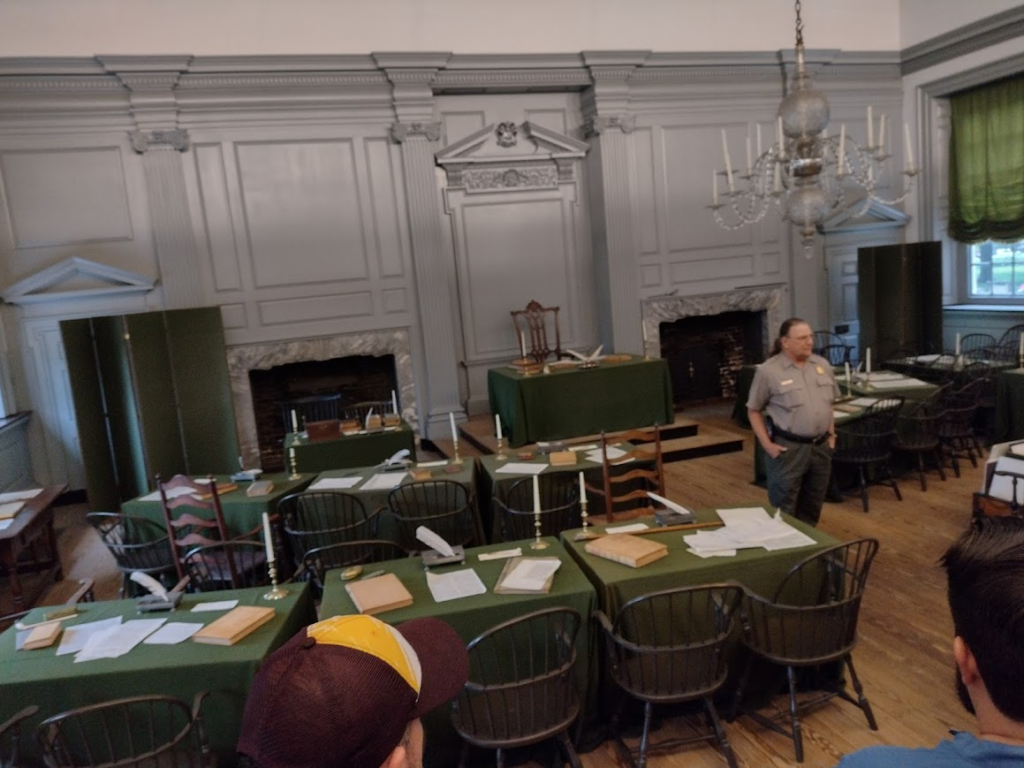
So what, you are probably asking, does this have to do with our little Library hidden away by a beautiful river on the fringes of the Highlands? Well, more than you may imagine! The story told through this letter shows how this event was being viewed at the time by a man very much at the heart of events; yet even he did not correctly foresee how history would come to remember it. At Innerpeffray, we have a number of books from 1776 that give us an insight into contemporary accounts of what happened over those fateful few days in July. I want to shine a little spotlight on these, as they reveal some fascinating insights into how the nation-building in Philadelphia was viewed in the drawing rooms, coffee houses and, of course, libraries of Britain three thousand miles away.
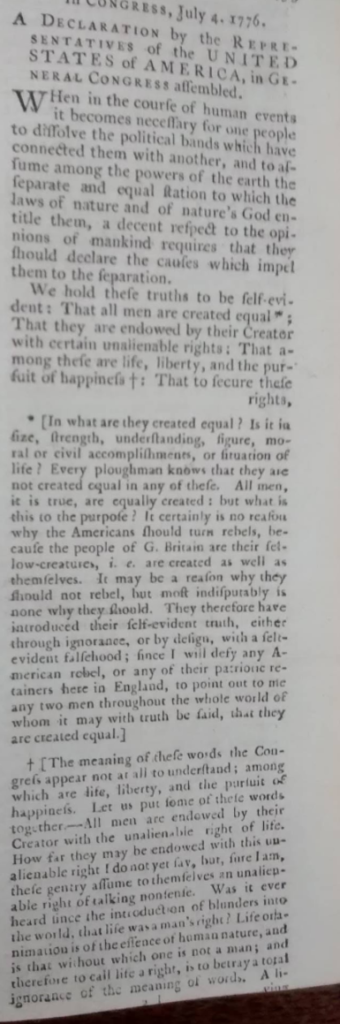
I’ll start with perhaps our most popular account of the Declaration of Independence. This lies within the August 1776 edition of the Scots Magazine and includes the first Scottish printing of the Declaration itself, as well as a most fascinating editorial rebuke. The Scots Magazine typically takes a very neutral stance on events, even with the Jacobite rising in 1745-6. Here, however, the tone is set from the beginning of their first footnote “In what are they created equal? Is it in size, strength, understanding, figure, moral or civil accomplishments, or situation of life? Every ploughman knows that they are not created equal in any of these.” Ooft! It goes on “I will defy any American rebel, or any of their patriotic retainers here in England, to point out to me any two men throughout the whole world of whom it may with truth be said, that they are created equal.”.
Vitriolic almost! Turning the page, I love the next column where we have three more lines of the Declaration and the rest is entirely editorial commentary, including a rather remarkable reference to cabbage-stalks and broomsticks and a slightly more sombre one to slavery “slaves there are in America; and where there are slaves, their liberty is alienated”. What we see here is, perhaps, the most obvious British response to the Declaration; absolute outrage that Americans could do such a thing! We see a strong focus on the areas that they feel they can easily challenge, but a lot less commentary in response to the actual grievances held by the American “rebels” (no editorialising of paragraphs such as “he [King George III] has plundered our seas, ravaged our coasts, burnt our towns, and destroyed the lives of our people”. We will return to these aspects of the Declaration with our final book.
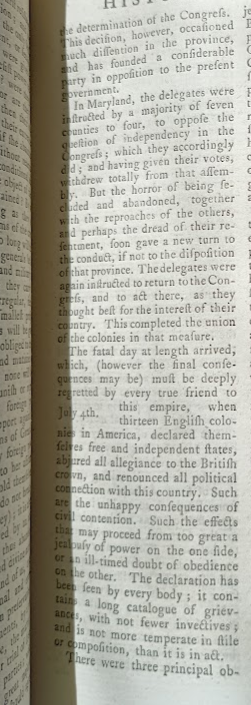
Whilst the Scots Magazine is one of the more popular books at Innerpeffray, our next book suffers somewhat from being located on one of the top shelves. The Annual Register’s pedigree is almost as ancient as that of the Scots Magazine and it is similar in scope, except that it was only produced annually rather than monthly (and, admittedly, it was so lengthy and difficult to compile that the 1776 edition was not exceptional in being published three years after the year it describes!). As such, this is a less contemporaneous account and it is notably brief in commenting on the impact of the Declaration. It is, perhaps, made more poignant by the fact it was written in the depths of the Revolutionary Wars and the author is left reflecting on the immense cost, both financial and in lives, of the conflict with the line “Such are the unhappy consequences of civil contention”. The author’s pro-British allegiance is shown clearly by his statement that “the fatal day… must be deeply regretted by every true friend to this empire”. Clearly some significance was attached to the Declaration, but it was already receding – at least to this author – into the background compared to the myriad other events that had happened in the years following.
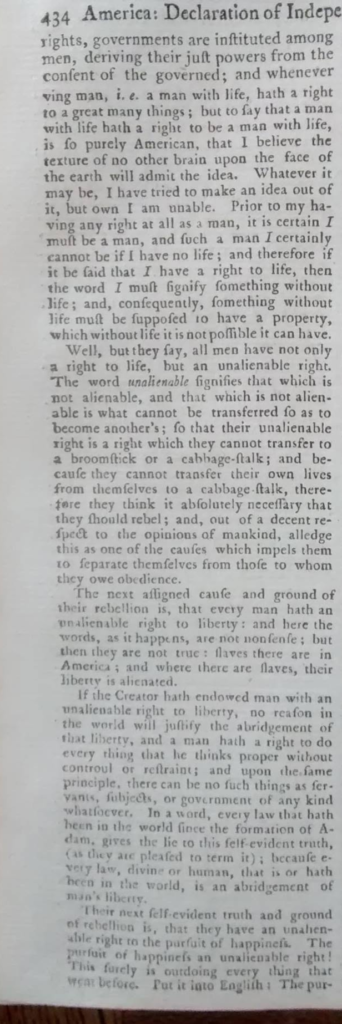
Figure 3: 3 lines of Declaration; 60 lines of commentary!
So far, we have seen two very pro-British accounts of the Declaration itself, as you may expect from a Scottish Library. Our final book, however, breaks the trend somewhat, and in a rather unusual way. The Monthly Review was the first literary journal to be published in the UK, starting in 1749, and contained reviews of recently published books. The reviewers could be uncompromising in their comments – one book, “by a student in the Inner-Temple”, gets a single line of “The Writer declaims vehemently and reasons badly”. The Review was published monthly and then bound together biannually and most months throughout 1776 have a section on the “American controversy”. What is quite fascinating is just how many of the reviews demonstrate a strong pro-American bias.
Figure 4: Extract from the Annual Register, showing the author’s resignation at the Declaration
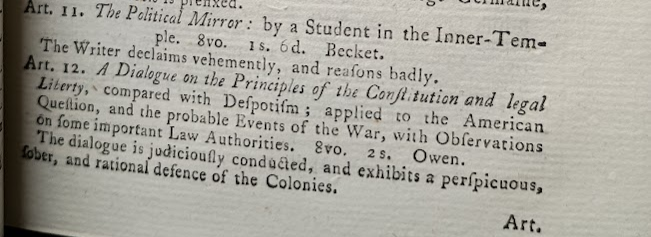
Obviously, without access to the works themselves, it is difficult for us to judge for ourselves how well written these books were, but it is difficult to imagine that all pro-British works were “so illegible that the devil himself could not make out the meaning” whereas all pro-American books “exhibit a perspicuous, sober, and rational defence of the Colonies”. I have previously written about the different reviews on the topics in my “Tour of the Tops” series here: https://innerpeffraylibrary.co.uk/tour-of-the-tops-episode-6-a-shameless-catch-penny-jobb/
Perhaps it is of little surprise that the Monthly Review is on the side of the colonists; after all, it was founded by a non-conformist minister, Ralph Griffiths. The Review will also reflect the sentiments of many in Britain at the time, given the splits that existed within the government, as well as the population at large, over how to handle the American situation. Even some individuals seemed to hold simultaneous conflicting views on the matter. Dr. Richard Price, whose pamphlet “Observations on the Nature of Civil Liberty, the Principles of Government, and the Justice and Policy of the War with America” crops up frequently throughout the Monthly Reviews of 1776, was a British author who was presented with the Freedom of the City of London a few years before receiving a Doctor of Laws degree from Yale College alongside George Washington!
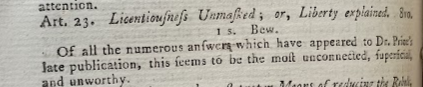
He is credited by some with pushing the Americans to declare independence, yet attacked the actual Declaration in 1784, particularly over slavery, stating “if there are any men whom they have a right to hold in slavery, there may be others who have a right to hold them in slavery”.
To conclude, as we celebrate 250 years since the Declaration of Independence, its legacy remains complicated. Some see the beacon of freedom shining out from the pens of the 56 men who signed it as they faced down the mightiest empire in the world, ready to lay down their lives for the causes they believed in, whereas others see only a group of white middle / upper class men who were angry at being asked to pay taxes they had not voted on, claiming rights that they did not feel the need to extend to others, notably women and slaves. It is clear from the three books discussed herein that the flaws and strengths of the Declaration were apparent from the very beginning to the varied audiences who came across it in the weeks and months following its signing. It is incredible to think that the words set out by Franklin, Jefferson, Adams and others in Philadelphia over late June and early July 1776 were being read in our little Library mere weeks later and here we are, 250 years later, still marvelling at what was set in train. Whatever your personal views or politics, it is undeniable that Declaration was one of the most consequential documents ever produced and its impact continues to reverberate down the centuries, even in a small Library by the banks of the Earn.
Images via Google images and courtesy of Library of Innerpeffray volunteer (RS).
RS