
“Traist cousing, we greit ȝow well.”
Currently on display at Innerpeffray Library is a book on loan to us from Culture Perth & Kinross, a collection of Perth Court records from Mary Queen of Scots’ reign. Opened for viewing is a letter, signed by Queen Mary, addressed to an unnamed party in secretary hand, a difficult script used in court documents as an early form of anti-forgery. The language of the letter is middle Scots, a language closely related to English and by large mutually intelligible, though it has its own quirks and spellings, such as using ‑it where English would have ‑ed in verbs; having ‑is for plurals where in English there would be ‑s; or the consonant combination quh– for wh– in English.[7] Other orthographical practices are more usual to the period: such as the use of þ (thorn) where th would normally begin a word in English – though in this letter (and for the time period) þ appears more like the letter y. The letter ȝ (yogh) was also common, being employed where a y would begin a word in English. These two are shown below in the words þe (the) and ȝow (you).
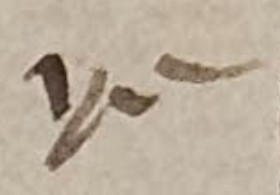
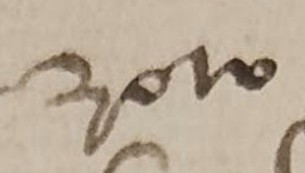
The greatest challenge of transcribing the letter was the handwriting, being designed specially to be uncopiable. As such, much of the original letter is of questionable reading.
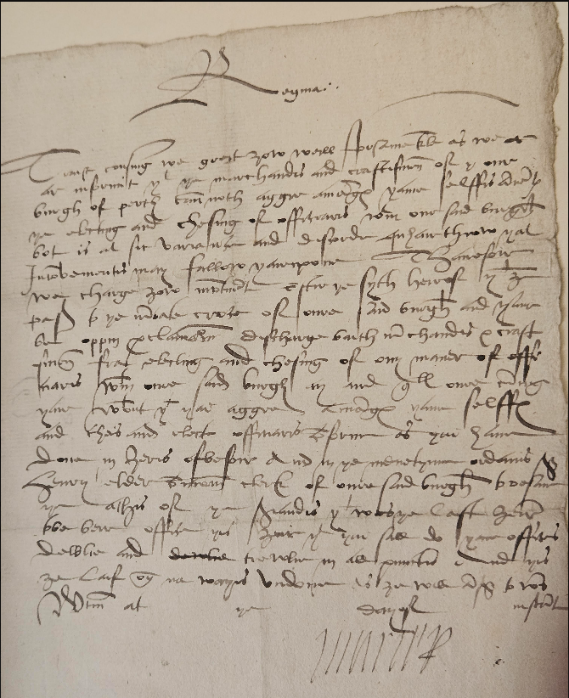
There was also the issue of clarity. Many of the individual characters are so similar as to give entirely differing readings: e and r, for example, are practically identical; as are s and f, owing to the use of the antiquated long s, ſ; u and v too were interchangeable for the time period. There are no dotted i’s, leading to confusion between what may be an m, or in; and t may be mistaken for l, s, or c, given that the secretary c appears as a straight downstroke with a bar, looking like either the uppercase Greek γ or Latin l.
Three words of particular difficulty stand out:
Incontinent (immediately), spelled ınɔ̄tnēt
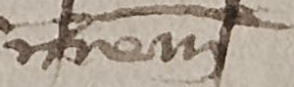
Intowin (in-town), spelled ītw̄ın
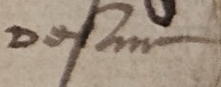
Conesarve (conserve), spelled ɔeſarv
All three are heavily contracted. Incontinent and conesarve make use of a scribal abbreviation, ɔ, standing for con, here appearing similar to an o or u. The bars over the letters may indicate a loss of letters or a following n or m, as is seen twice in incontinent, above the inɔ, and above the e. Sometimes, the missing letters are not indicated at all, as again is shown in incontinent, where the i after the t is not written nor shown to be contracted.
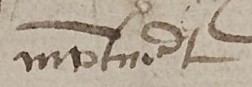
Alongside this are the letters that bear no similarity to their modern counterparts whatsoever; for example, there is a word (shown below) that only after careful examination and context may be read as syr (sir), as it is immediately followed by the name Henry Elder – who can be found in the records as Sir Henry Elder.[8]

Deciphering the letter forms and words took many hours of cross-referencing between words that could be read without doubt and using that knowledge to work out what may be written in those words that lack clarity. In this task, I had invaluable help from my fellow volunteers; Honor and I spent long hours looking over the letter, checking our readings through the Chambers Concise Scots Dictionary and online resources such as Dictionaries of the Scots Language; and Gillean provided several PDFs on secretary hand, allowing me to crack the more impenetrable spellings. Without this help, I doubt I could have completed the transcription.
Transcription of the original:
Regina
Traist cousing, we greit ȝow well. Fforsamekle as we ar informit þat þe marchandis and craftismen of our burgh of Perth can noth aggre amangis þame selffis anentis þe electing and chesing of officiaris within our said burgh’s; bot is at sic variance and discorde quhairthrow þat inconvenientis may fallow þairupone. Thairefore, we charge ȝow incontinent eftir þe syth hereof þat ȝe pass to þe Mercate Croce of oure said burgh’s, and þair be oppin proclamatioun discharge baith marchandis & craftismen fra electing and chesing of ony maner of officiaris within oure said burgh ay and tyll oure coming þair. Without þat, þae aggre amangis þame selffis and cheis and elect officiaris unto forme as þae have done in ȝeris of-before; and in þe menetyme ordanis Syr Henry Elder unto intowin clerk of oure said burgh’s, to conesarve þe athis of þe syrvandis, þat was þe last ȝere’s, to be bere office þis ȝere þat þae sall do þair officis delblie and trewlie in all pointis, and þis ȝe laif on na wayis undone, as ȝe will ansyr to ws. Writtin at þe day of instant.
MARIE R
Translation into modern English:
Regina
Worthy kinsman, we greet you well. For as much as we are informed, that the merchants and craftsmen of our town of Perth cannot agree amongst themselves concerning the electing and choosing of officials within our said town; but is at such variance and disagreement thereof that inconvenience may follow thereupon. Therefore, we charge you immediately after the time hereof that you pass to the Mercat Cross of our said town, and there by open proclamation discharge both merchants & craftsmen from electing and choosing of any manner of officials within our said town until our coming there. Besides that, they agree amongst themselves and choose and elect officials unto form as they have done in years before; and in the meantime, ordain Sir Henry Elder unto intown clerk of our said town to conserve the oaths of the servants, that were the last year’s, to bear office this year, so that they shall do their offices doubly and truly in all points, and this you leave in no way undone, as you will answer to us. Written on the day of instance.
MARY R
As for who the letter is written to, it is never stated, the name Henry Elder appears in passing, as though the addressee was being told what is to happen. There is also no date of composition, despite the ending statement “Writtin at þe day of instant”, but it can be inferred through historical context.
For one, Mary is queen, and Sir Henry Elder was banished in 1544 for being protestant, and replaced by William, 2nd Lord Ruthven in 1545;[8][10] placing the date between her anointment in 1543 and 1544. This is mind, she was merely a year old at her coronation, so she must have been a few years older at the time of writing, so perhaps this letter was written in 1544. This could explain the scrawly appearance of her signature, though it seems very doubtful that a two-year-old child would have signed the document.
Her mother, however, Marie de Guise, was regent for her daughter during the queen’s stay in France, having assumed the regency from the Earl of Arran in 1554 until her death in 1560. She is known to have abolished the offices of the Deacons of the Crafts in 1555, causing heightened resentment.[2] Following this, she travelled to Perth to meet with those who opposed the act, repealing the abolishment shortly thereafter. This is a plausible date for the letter, possibly the letter that initially caused the dissention; and would explain the spelling of Marie in the manuscript, followed by the initial R, possibly for Regent (though this is admittedly unlikely, especially given the use of Regina at the beginning of the letter). But the mentioning of Henry Elder puts this claim into dispute, as there is no reason for him to be reappointed prior to the Protestant Reformation of 1559-60, and there is no record of such an event occurring.
It is possible that the letter was written after Mary’s return to Scotland in 1561, and that Sir Henry was reinstated into office not too long after (William, Lord Ruthven had died in 1552[9]). Patrick, 3rd Lord Ruthven became Provost and Constable of Perth following his father’s death in 1552. He was raised into the Privy Council in 1563,[4] and died in 1566, succeeded by his son and heir, William, 4th Lord Ruthven and 1st Earl of Gowrie; however, the source does not state whether he took up his inherited role or passed responsibility onto someone else.[9] This could be when Sir Henry came back into power in Perth, taking over the role of Town Clerk in Patrick’s absence or in William’s stead, and so dating the letter between 1563 and either William’s ascension in 1566 or Mary’s abdication in 1567.
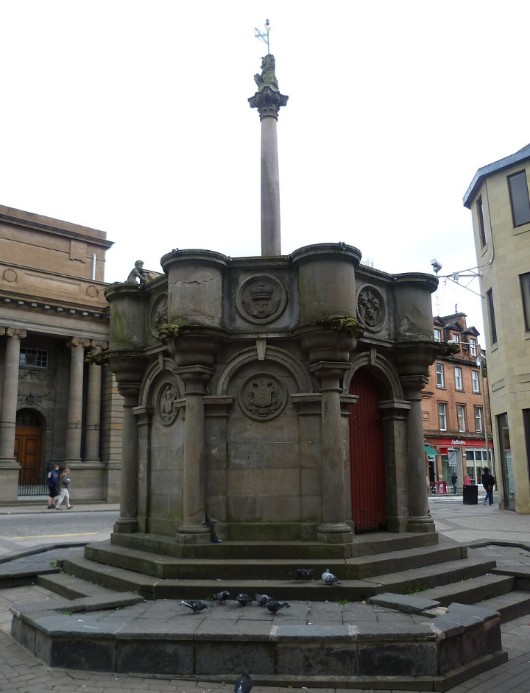
What is clear is where the addressee is to perform his proclamation; the letter mentions Mercate Croce, today known as Mercat Cross (shown left). This was the epicentre of Perth’s commercial district throughout most of the city’s history; though, the location has shifted several times. The original site’s location is not known,[5] and it seems that the original is where the addressee spoke, the second Cross having been erected in the 17th century, at least fifty years after the letter’s composition.[5] Today, the Cross sits between the St. John’s Centre and the Perth Museum.
Some of the letter remains an enduring mystery, full of speculation; but overall, much has been revealed through trial and error. I’m truly grateful for having had this opportunity to study such an historically rich document. And to those who have helped in this endeavour, I give my heartfelt thanks.
JH
Bibliography
- Dictionaries of the Scots Language: https://dsl.ac.uk
- Mary of Guise. Wikipedia: https://en.wikipedia.org/wiki/Mary_of_Guise
- Mary, Queen of Scots. Wikipedia: https://en.wikipedia.org/wiki/Mary,_Queen_of_Scots
- Patrick Ruthven, 3rd Lord Ruthven. Wikipedia: https://en.wikipedia.org/wiki/Patrick_Ruthven,_3rd_Lord_Ruthven
- Perth mercat cross. Wikipedia: https://en.wikipedia.org/wiki/Perth_mercat_cross
- Perth, Scotland. Wikipedia: https://en.wikipedia.org/wiki/Perth,_Scotland
- Robinson, M. (Ed.). (1996). The Concise Scots Dictionary (1996 ed.). Chambers.
- Todd, M. (2012). Scottish History, the Protestant Reformation in Perth. Future Learn: https://www.futurelearn.com/info/courses/ems-palaeography/0/steps/30872
- William Ruthven, 1st Earl of Gowrie. Wikipedia: https://en.wikipedia.org/wiki/William_Ruthven,_1st_Earl_of_Gowrie
- William Ruthven, 2nd Lord Ruthven. Wikipedia: https://en.wikipedia.org/wiki/William_Ruthven,_2nd_Lord_Ruthven