
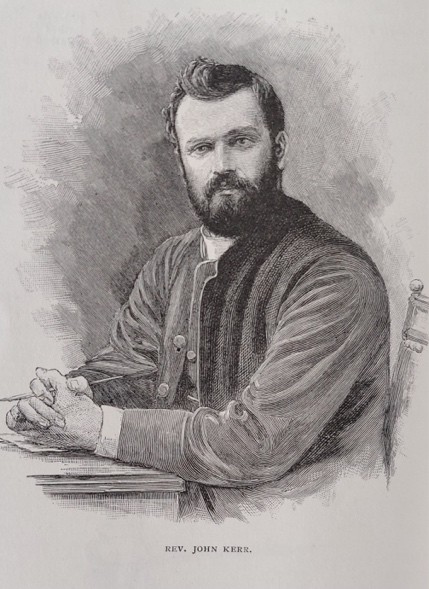
The 2026 Winter Olympics have now ended and the UK’s four-yearly cycle of falling in love with the sport of curling has faded into the background yet again. But have you ever wondered how the spectacle of teams of people throwing huge granite stones across a sheet of ice came about? Answers can be found on Innerpeffray’s shelves in a book titled ‘The History of Curling, Scotland’s Ain Game’ which was published in Edinburgh in 1890. Written by the Rev. John Kerr (who was known as the sporting padre) the book was intended to be read both as a history of the sport itself and an account of the development of the Royal Caledonian Curling Club which was celebrating its fiftieth anniversary in the year of publication.
Kerr wrote at length in his book about the possibility that curling was imported into Scotland by artisans and refugees from Flanders. As early as the 1400s, Scottish monarchs had welcomed Flemish artisans and employed them to plug gaps in the workforce and improve the country’s infrastructure after long periods of war and destruction. Those Flemings brought their culture and language with them and it had long been debated in curling circles, Kerr stated, whether imported European and Scandinavian ‘ice games’ and their related language in fact led to the development of the sport and the vocabulary of curling. Kerr noted that there were as many arguments to discount a Flemish origin of curling as there were in support of the notion.
Firstly, there had always been ice in Scotland and so it was natural to suppose that games had been played on it. Secondly, the etymology of curling language included words rooted in Doric and so a Scottish origin of the game was more likely. Thirdly, Flemings had settled in England and Wales as well as Scotland and there was very little evidence of ice games like curling in those countries. Finally, Kerr outlined the theory that curling had developed in Scotland through the enforced idleness of rural workers in winter; land and lochs were frozen so workers got together to amuse themselves with games played on ice. The Scots diaspora then spread the game to many parts of the world – mostly to countries in the British Empire such as Canada and New Zealand but also to Russia, Scandinavia and the USA.
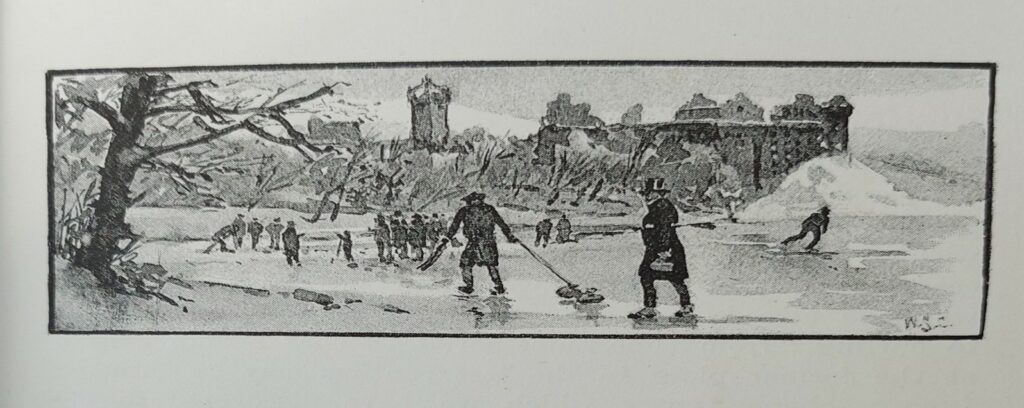
Kerr wrote at length about the development of curling societies in the 1700s, their strict adherence to the principle of brotherhood and their possible links to freemasonry. There were several leading curling clubs/societies in the general vicinity of Innerpeffray eg Ardoch, Bridge of Allan, Strathallan, Doune and Muthill which held the oldest records. Clubs played matches against each other outdoors on frozen ponds/lochs or on artificially created ice rinks. They strove to uphold the reputation of the game by playing in the right spirit, by sticking to the rules as they existed at the time and by prohibiting any wagers. The Statistical Account of Scotland (1790-99) gave accounts of the good-natured spirit of competition during matches and of post-match friendliness. Different ranks of society played together on the same rinks and ate together – lunch and a post-match dinner of ‘… beef, greens and toddy.’ In those days, the players were usually male and the food was provided and served by wives and other women. There were fines for infractions and infringements of club rules.
Each curling society held administrative meetings and minutes were kept from which Kerr was able to deduce links to freemasonry eg initiation ceremonies, the importance of brotherhood, the use of passwords, a prescribed grip and selection for membership based on agreed criteria. Intemperance was strongly discouraged, rules of behaviour and play were enforced and charitable activities were encouraged. Membership fees were often charged by societies and over time this affected the societal mix of players.
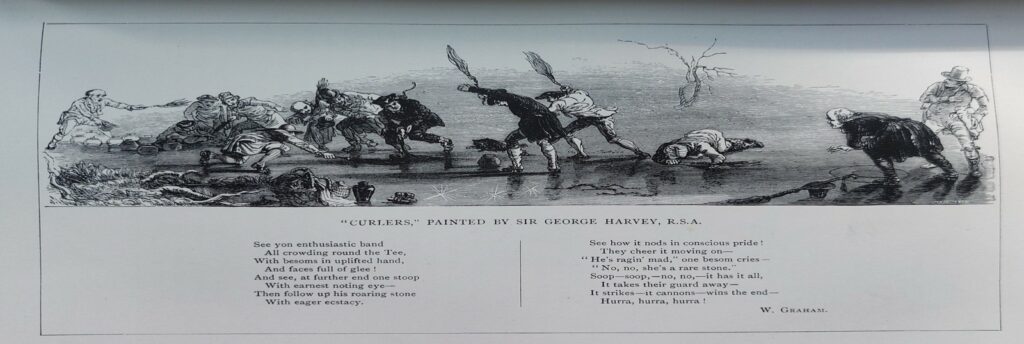
Curling was, Kerr proposed, associated with the Stuart monarchs but he acknowledged a lack of written evidence for this. Literature, however, did confirm it was a game played by cottars, working men, the clergy and the gentry. Numerous examples can be found of commentary, songs and poems written by established authors in celebration of the game eg Allan Ramsay, Sir Walter Scott, Robert Burns, Thomas Pennant (see poem in the above illustration.)
Any cursory examination of the modern game on TV reveals how the modern sport is played eg; how players are dressed and shod; the standardisation of indoor ice sheets (size and markings) and the position of footholds (hack); the standardisation of stones, team numbers, number of ends to be played, conduct, equipment used and rules for play. But what did Kerr have to say about how the game was played in the early days of curling clubs? In the past there was more variation between districts, that is until the rules were formalised by The Royal Caledonian Club which was formed in 1838 to bring together representatives of as many Scottish curling clubs as possible – and eventually some English and overseas clubs – to standardise the sport under one governing umbrella. A Grand Lodge was also convened to promote and extend the aims of brotherhood in the sport, but today there is no evidence of freemasonry in the modern game of curling.
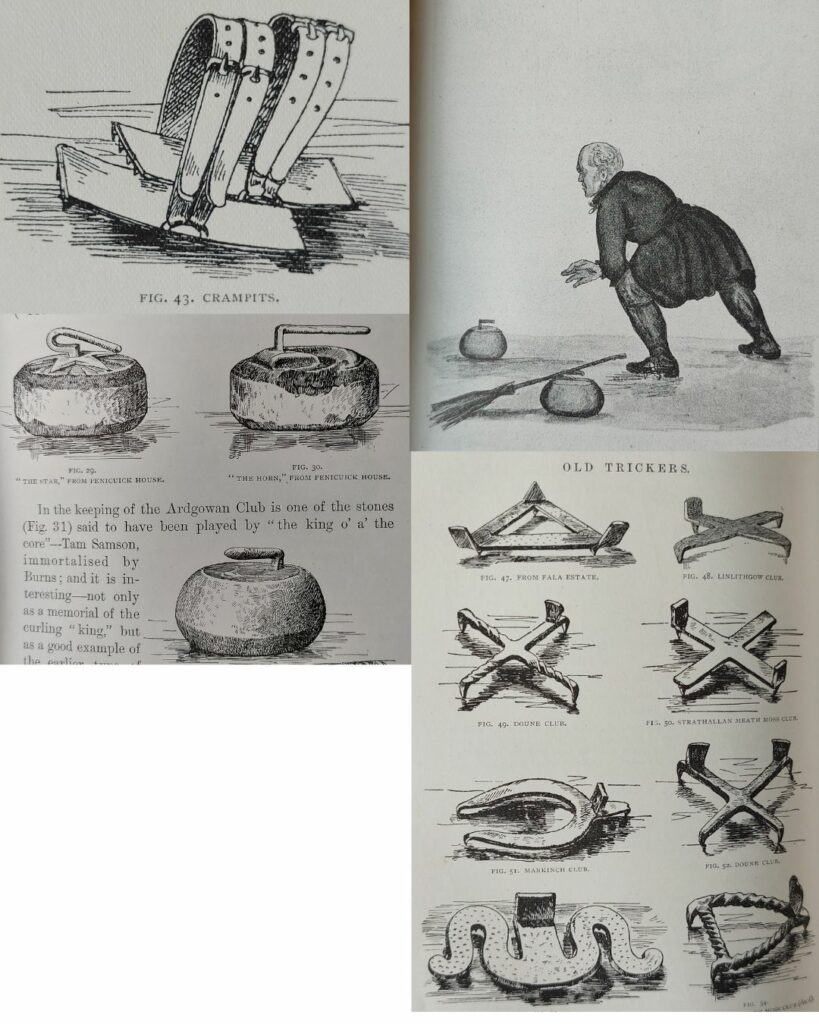
Curling stones were originally known as Kuting Stanes or Channel Stanes (which were sourced from riverbeds) and were used from around 1500 until 1650 to play a game on ice that resembled quoits. From 1650 until about 1800 stones were rough blocks – heavier, bulkier and gathered from fields, dykes, mountainsides etc- with handles inserted into them so that players could hurl the stone onto the ice with more force. Brushes looked more like brooms of twigs (see illustrations above and below) and players wore their everyday shoes covered in crampits to allow a firm foothold on the ice. As time went on the crampits were inserted into the ice and acted as a fixed starting point; or a hole (the hack) could be dug out of the ice to form a foothold. The curling stones themselves could vary in size, shape and weight but today they are all made from granite quarried on Ailsa Craig and manufactured to an internationally agreed format.
And a final note on the sporting padre, Rev. Kerr himself. He was chosen for the task of writing ‘A History of Curling’ by the literary committee of the Royal Caledonian Curling Club. He studied Divinity at Glasgow University and graduated with an MA. In later life he was elected as a Fellow of the Royal Society of Edinburgh. As well as being minister of Dirleton Parish in East Lothian for most of his ministry he was a keen amateur sportsman (golf, curling and skating) and wrote books on all three sports.
S.A. Williams
March 2026
All images are reproduced by kind permission of the Trustees of the Library of Innerpeffray